You may have heard of “trauma-informed” yoga. What is it, and who is it for? I invite you to check out the support resources at the end.
What is it?
A trauma-informed yoga practice is typically offered in environments where participants come from experiencing or are at a higher risk of re-experiencing violence, addiction, and other traumatic patterns of experience.
Who is it for?
This is yoga offered in prisons, in addiction rehabilitation centres, to survivors of gender-based violence (GBV), and in other vulnerable spaces such as rehabilitation for brain injuries.
Truth be told, it really should be more commonly accessible in less-seemingly traditionally vulnerable spaces, particularly for people of colour.
More on that another time.
How is it different?
Trauma-informed yoga practices tend to focus on the following:
- Gentle empowerment: using inviting language
- Understanding disconnect: bringing awareness to the body and to the breath can feel unsafe and triggering
- No touching!
- Safety: physical and emotional
Language and disconnect
In a typical yoga studio class for the general public, you may hear teachers give instructions/directions one after the other, or mention things to the effect of:
- Bring your awareness to your breath.
- Close your eyes/take your gaze (here).
- Experience your experience.
This is not often available to participants in trauma-informed spaces. Here, participants are often disconnected from noticing their breath and from the sensations in their bodies; they wouldn’t have survived, otherwise.
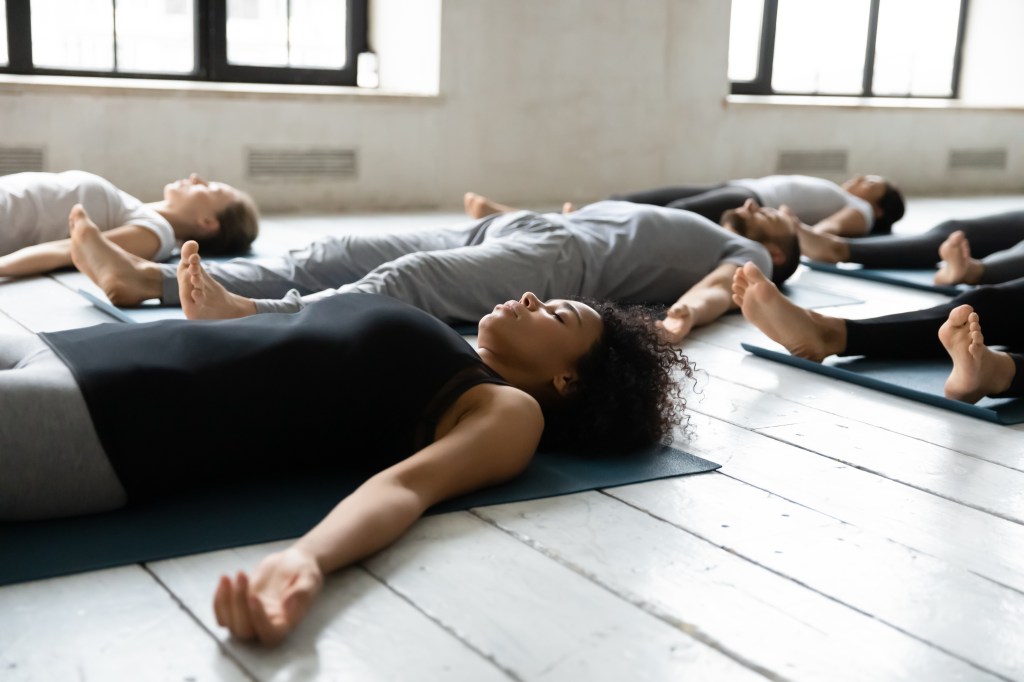
Trauma-informed yoga practices typically use inviting language to empower participants with options and choice. So in these spaces, participants don’t have to close their eyes to meditate or in savasana; they choose whether they feel ok to notice their breath or not, and that choice can change throughout the practice.
It’s about creating an allowing space where, without apology, participants can just be, as they are.
I usually take more time to explain practices upfront and during in order to support empowerment; it’s hard to say yes/no to something if you have no idea what’s coming.
Movement
The choices of movements (asanas) in trauma-informed practices are different; we’re not aiming for headstands or deep contortions.
Here, the practice is more “dosed” according to the needs of the participants. For example, in practices for survivors of GBV, one wouldn’t guide a participant into movements that open up the pelvic region (ie: happy baby).
Because individuals in these practices have a higher need to discharge stored up trauma/energy in the body, and a harder time sitting still, the practices may move quicker at first before participants can feel more comfortable sitting still/meditating. This is in contrast to a typical yoga studio practice where there is often initial centering/noticing the breath.
No contact
No touch. Just don’t. Again, this is part of creating a safe space for participants with healthy boundaries that doesn’t assume or push them into triggering spaces.
Safety
This is connected to the sections above regarding movement and no contact; it’s important for participants to be in familiar spaces (if possible) and to have eyes on the entire space and the facilitator.
In these practices, for savasana/final relaxation, participants will lay down as they are comfortable; I usually find that participants will lay down with their feet towards the facilitator/front of the room so they can lift their heads to scan the room at any moment.
This is contrary to traditional savasana yogic practices, where students are instructed to to lay down facing the back of the room with no visibility of the facilitator behind them.
Resources
The following are useful resources related to yoga and trauma support.
 Nourish The Yin